
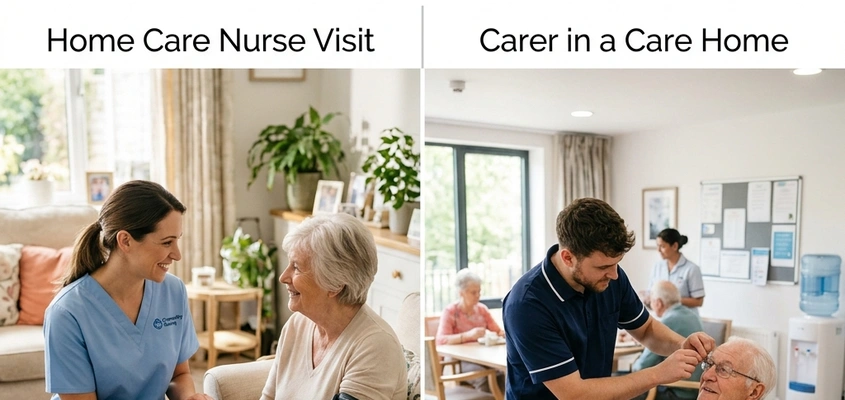
Home Care vs Care Home Staffing UK 2026: Ultimate Recruitment Choice
Table of Contents
Social care providers operate across distinct delivery models. When evaluating home care vs care home staffing UK 2026, managers must recognize the unique recruitment requirements, scheduling patterns, and compliance rules of each sector. This guide compares both models and outlines strategic recruitment approaches.
1. Comparing Home Care vs Care Home Staffing UK 2026
The adult social care workforce is split between residential care homes and home care (domiciliary) services. Evaluating home care vs care home staffing UK 2026 reveals that each model faces unique retention and recruitment challenges. While care homes require structured shift cover, home care services rely on autonomous travel and flexible rosters.
Understanding these operational differences is key to designing effective recruitment campaigns. Providers must adapt their benefits and support structures to the specific role type. Choosing the right staffing strategy keeps care delivery safe and efficient, which is a major factor in the home care vs care home staffing UK 2026 decision.
2. Care Home Staffing: The Controlled Environment Challenge
Care homes operate in a centralized, regulated facility. Recruitment focus centers on clinical team dynamics, night shift coverage, and meeting CQC-regulated ratios. Because staff work in a shared space, hiring candidates who fit your organizational culture is essential.
Additionally, care homes require registered nurses to oversee high-dependency units. According to the Care Quality Commission (CQC) guidance, care providers must prove that staffing levels are safe on every shift. This makes rapid temporary cover a vital operational resource, especially under the home care vs care home staffing UK 2026 comparison.
3. Home Care Staffing: The Dispersed Workforce Challenge
Home care services present a dispersed, mobile workforce. Key challenges include routing efficiency, unpaid travel time, and lone-working safety. Domiciliary care workers need high clinical competence and the confidence to operate independently in client homes.
Retention in home care is highly dependent on travel support and shift organization. Providers must offer clear route planning and fair mileage reimbursement to keep staff engaged. Managing isolation is also key to retaining domiciliary care workers in the home care vs care home staffing UK 2026 framework.
4. Managing Travel and Lone Working Safety
Home care settings demand strict lone-working safety procedures. Since carers operate independently in private residences, managers must implement digital check-in systems and GPS tracking for safety. Providing emergency alarms and regular safety briefings reduces risk.
Additionally, route optimization helps minimize travel times and expenses. When scheduling is efficient, carers spend less time driving and more time delivering care. This improves job satisfaction and directly supports retention goals.
5. Selecting a Specialist Recruitment Partner
Both models require specialized recruitment solutions. Working with Workforce Bridge gives care providers access to vetted, compliance-ready personnel for both home care and care home settings. We verify DBS clearances, qualifications, and references before any placement.
Our staffing specialists match candidates to the specific demands of your service model. Learn about our healthcare staffing solutions or contact Workforce Bridge to build a sustainable recruitment plan for your care service, resolving your home care vs care home staffing UK 2026 challenges.
6. Frequently Asked Questions
Which care model has a higher staff turnover rate?
Home care services historically experience slightly higher turnover. This is driven by travel demands, isolated working conditions, and scheduling pressures.
What is the Care Certificate in UK social care?
The Care Certificate is a set of 15 standards that health and care professionals must meet in their daily work. It is designed to ensure consistent, high-quality care delivery.
How can care homes manage night shift recruitment?
Offering night shift premiums, structured rotas, and clear career paths helps attract nurses and carers to permanent night positions.